Skip to content

The Flu & Your Period: How They’re Connected & What You Can Do
Feeling like you got hit by a truck, and now your period has gone rogue too? You're not imagining it. The flu can throw off your menstrual cycle, and so can being sick in general: colds, COVID, that stomach bug your coworker so generously shared.
TLDR; Yes, the flu can delay your period. Less often, it can make your period come early, or turn up heavier, lighter or crampier than usual. It usually only affects your next cycle, and most people are back to normal within a month or two. If there's any chance you could be pregnant, take a test. If you miss three periods in a row, it's time to call your doctor.
Here's what's actually going on (nerdy hormone stuff ahead, you've been warned).
Why being sick messes with your cycle
Your cycle runs on a hormone chain of command: your brain signals your ovaries, and your ovaries respond. When you get sick, your body hits the stress-response button, and that chain gets interrupted.
The stress hormones CRH and cortisol dial down kisspeptin, the signal that tells your brain to release GnRH. GnRH is what sets up the LH surge that triggers ovulation. Less GnRH means no LH surge, and no LH surge means ovulation has to wait (Vigil et al., 2022). Your body's logic is pretty simple: we're busy fighting a virus, so this is not the month to prioritize reproduction.
We asked Naturopathic Doctor Paria Vaziri how the flu could affect your period. She said, "Getting sick puts a strain on your immune system, increases overall inflammation in the body, and can cause changes in sleep and appetite. Because of this, it can be normal to experience delayed ovulation (aka getting your period late) and potentially more symptoms around your period (like more cramps than usual)."
And your routine going out the window doesn't help. "Other areas that can further amplify the impact of getting sick include not getting proper sleep, being sedentary, loss of appetite, and dehydration," Dr. Paria told us.
Can the flu delay your period?
Yes, and a late period is the most common change. Here's the detail most articles skip: your period is late because ovulation is late. So when you get sick in your cycle matters.
- Sick before you ovulate (the first half of your cycle): this is when illness is most likely to push back ovulation, and your period along with it.
- Sick after you ovulate (the second half): the luteal phase tends to be more consistent in length, so your period is more likely to arrive close to on time. Your PMS symptoms might be louder than usual, though.
We don't have great flu-specific data (women's health research, we see you), but COVID gives us a useful look at what a big respiratory infection does. In one study of 177 women with COVID, 28% had changes to their cycle, and the most common was a longer cycle, seen in 19% (Li et al., 2021).
The same stress response applies to any illness that knocks you down, including a bad cold. In general, the harder an illness hits you, the more likely it is to show up in your cycle.
How long can the flu delay your period?
There's no universal number, but the pattern is consistent: it's usually just one cycle. "For most, the next period you have is most likely to be impacted although in severe cases multiple periods can be impacted," Dr. Paria told us.
The research agrees. In the COVID study above, 99% of the women whose cycles changed were back to their normal cycle within one to two months (Li et al., 2021).
If your period is late after being sick:
- Take a pregnancy test if there's any chance. Being sick doesn't rule it out.
- Note when you were sick in your period tracker, so you can see whether your cycle bounces back.
- Call your doctor if you miss three periods in a row. That's the point where a missed period gets looked into as its own issue (Cleveland Clinic).
Can being sick make your period come early?
It can, but it's less common than a late period, and there's less research on it. Most of the evidence on illness and the cycle points toward longer cycles, not shorter ones.
If your period shows up early once after you've been sick, it usually isn't a cause for concern. If it keeps happening, or you're bleeding between periods, bring it up with your doctor.
Can the flu make your period heavier, lighter or more painful?
Yes. Timing isn't the only thing that can shift.
- More cramps: Dr. Paria flagged this one. Fighting an infection ramps up inflammation, and inflammation and period pain are closely linked.
- A lighter period: In the COVID study, 25% of women had changes in flow, and most of those periods were lighter (20%) (Li et al., 2021). Your medicine cabinet could be playing a part too. NSAIDs like ibuprofen and naproxen are known to reduce menstrual blood loss (Bofill Rodriguez et al., 2019), so if you've been taking them for body aches, that may explain a lighter flow.
- Spotting: Light spotting around an illness can happen. If it keeps going or gets heavy, check in with your doctor.
Got the flu and your period at the same time?
The worst combo, truly. Body aches, fatigue and cramps all stack on top of each other, and fever plus blood loss makes it easier to get dehydrated. A few things help:
- Drink more than you think you need. Broths, water and electrolyte drinks all count.
- Let one pain reliever do double duty. An NSAID like ibuprofen can handle body aches and cramps at the same time. Many cold-and-flu combo products already contain a pain reliever, so check the labels (or ask your pharmacist) before you double up.
- Heat pad, always. Your uterus will thank you.
- Rest without the guilt. Your body is running two big jobs at once.
Can Tamiflu or the flu shot affect your period?
Tamiflu: Changes to your period aren't listed among Tamiflu's (oseltamivir's) known side effects (Mayo Clinic). If your cycle is off while you're taking it, the flu itself is the more likely cause. Ask your doctor if you're unsure.
The flu shot: A 2025 study of 1,501 people in JAMA Network Open found that getting the flu vaccine alone was linked to a cycle that ran about 0.4 days longer on average. Cycles went back to normal the next month (CIDRAP). That's less than half a day, and it was temporary. (Curious about COVID shots? We covered that here.)
Is it the flu or "period flu"?
If you feel flu-ish every month right before your period, you might be dealing with "period flu." It isn't actually the flu or a medical diagnosis. It's a type of PMS (Cleveland Clinic).
Before your period, estrogen and progesterone drop, and your uterine lining releases prostaglandins. Together, they can cause body aches, fatigue, headaches, nausea, diarrhea and sometimes even a low-grade fever (Cleveland Clinic).
How to tell them apart:
- Timing: Period flu shows up in the days before your period and fades once it starts. The flu doesn't care what day of your cycle it is.
- Respiratory symptoms: A cough, sore throat or stuffy nose points to an actual virus. These aren't part of period flu.
- It repeats: If it happens every cycle, that's your hormones talking, and it's worth supporting them. (Start with PMS vs. PMDD if your symptoms are intense.)
How to support your cycle while you're sick (and after)
The best thing you can do is take care of yourself, or let someone you love take care of you. Dr. Paria suggests, "Rest as much as possible, try to get in as many nutrients as you can (this is a great time for soups, broths, and juices), and stay well hydrated! In the aftermath, it may be helpful to bring in some adrenal and anti-inflammatory support."
A few more things to keep in mind:
- Eat something, even if it's small. Your appetite may disappear, but your cycle needs fuel. Here's how under-eating affects your period.
- Protect your sleep. It's when your body does most of its repair work.
- Ease back in. Being sick is a physical stressor, and stress affects your period. Don't jump straight back into your hardest workouts.
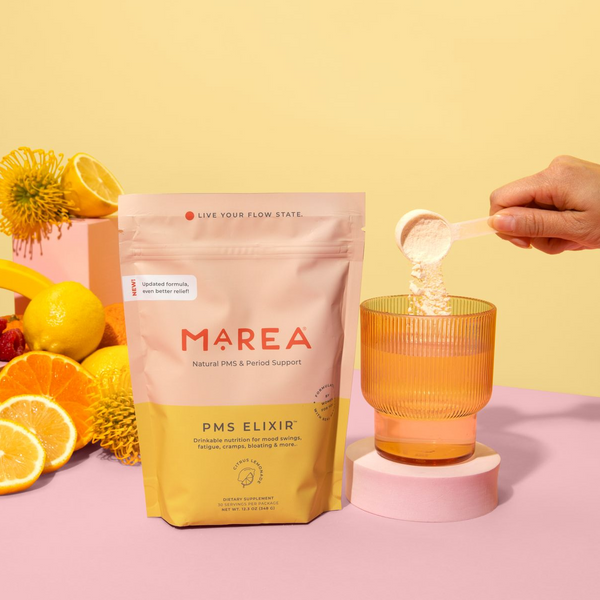
- Fill the nutrition gaps. If your diet took a hit while you were down, the PMS Elixir delivers 15 essential micronutrients in one drink, which makes it easier to get back to a consistent routine.

When to see a doctor
"Usually, you don't have to do anything [if your period is affected by the flu] and your period will go back to normal with the next cycle. However, if symptoms persist I would speak with your OB/GYN," suggests Dr. Paria.
Check in with your doctor if:
- You've missed three periods in a row (Cleveland Clinic)
- Your period is late and a pregnancy test is positive, or you're unsure
- Your bleeding is much heavier than normal, or you keep bleeding between periods
- Your flu symptoms are getting worse instead of better
FAQ
Can a cold delay your period? Yes, it can, through the same stress response as the flu. A cold is usually milder, so the effect on your cycle tends to be smaller.
Can being sick delay ovulation? Yes. That's the main way illness makes your period late: stress hormones slow down the signals that trigger ovulation.
How long can being sick delay your period? Usually just one cycle. Most people are back to normal within a month or two. If you miss three periods in a row, see your doctor.
Can being sick make your period come early? It's possible, but less common than a late period. If it keeps happening, talk to your doctor.
Does the flu shot affect your period? Only slightly. In a 2025 study, cycles ran about 0.4 days longer on average after a flu shot and went back to normal the next month.
Can Tamiflu delay your period? Changes to your period aren't a listed side effect of Tamiflu. If your cycle is off, the flu itself is the more likely cause.
The bottom line
If your cycle goes a little sideways after the flu, your body is doing exactly what it's built to do: putting recovery first. Rest up, drink the broth, eat something, and give your cycle a month to catch up. If it doesn't, that's your cue to call your doctor.