Skip to content

Period Flu: Why You Feel Sick Before Your Period (and What Helps)
Every month, like clockwork: the body aches, the exhaustion, the headache, maybe some nausea. You'd swear you're coming down with something, and then your period shows up. Surprise! It was your hormones the whole time.
That's what people call "period flu" (or "PMS flu" or "menstrual flu"). It's not an infection and it isn't contagious, but it's very real. Here's what causes it, how to tell it apart from the actual flu, and what helps.
What is period flu?
Period flu isn't the flu, and it isn't an official medical diagnosis. It's a type of premenstrual syndrome (PMS) that happens to feel a lot like being sick (Cleveland Clinic).
If you've ever felt personally victimized by your luteal phase, you're in good company. As many as three in four women get PMS symptoms at some point (Office on Women's Health). Period flu is just the version that comes with a side of "am I dying?"
Period flu symptoms
Period flu can include (Cleveland Clinic):
-
Body aches
-
Fatigue
-
Headaches
-
Nausea or vomiting
-
Diarrhea
-
A low-grade fever
It often tags along with classic PMS symptoms like cramps, bloating, breast tenderness, backache, trouble sleeping and mood swings (Office on Women's Health).
What causes period flu?
Two things happen before your period, and together they make you feel lousy.
1. Your hormones drop. If you're not pregnant, estrogen and progesterone fall in the days before your period. That drop can trigger headaches, fatigue and mood swings (Cleveland Clinic).
2. Prostaglandins ramp up. Cells in your uterine lining release prostaglandins, the hormone-like compounds that make your uterus contract so it can shed its lining. They don't always stay put, and they can cause diarrhea, nausea and even a low-grade fever before your period (Cleveland Clinic). Prostaglandins are also part of your body's inflammatory response, which is why inflammation and PMS are so closely linked.
When does period flu start, and how long does it last?
PMS symptoms typically show up in the five days before your period and end within four days after it starts (Office on Women's Health). So period flu can overlap with the first few days of your period too.
If you feel flu-ish well after your period has ended, or at random times with no link to your cycle, something else is probably going on. That's worth mentioning to your doctor.
Period flu, the flu or a cold?
The symptoms overlap, so look at the pattern:
|
Period flu |
Actual flu or a cold |
|
|---|---|---|
|
Timing |
Days before your period, fades once it starts |
Any time in your cycle |
|
Repeats monthly? |
Yes, usually the same time each cycle |
No |
|
Cough, sore throat, stuffy nose |
Not part of period flu |
Common |
|
Fever |
Low-grade, if at all |
Can be high, often with chills |
|
Contagious? |
No |
Yes |
"Why do I always get a cold before my period?" If your symptoms are mostly aches, fatigue and stomach stuff, it's probably period flu. If you really do get a runny nose or sore throat every month, write it down. Researchers are still working out how immunity shifts across the cycle, and a pattern in your tracker is useful to bring to your doctor.
And if it is the actual flu, it can mess with your cycle too. Here's how the flu affects your period.
Period flu treatment: what actually helps
Right now, while you feel awful
-
Take an NSAID. Ibuprofen and naproxen help with cramps, headaches and aches (Office on Women's Health). They also work by lowering prostaglandins, the same compounds behind a lot of period flu symptoms.
-
Use heat. A heating pad or warm bath for cramps and achy muscles.
-
Hydrate, especially if you're dealing with diarrhea or nausea.
-
Rest. Your body is doing a lot.
All month long, to make next month easier
-
Move regularly. Regular aerobic exercise throughout the month is a standard PMS recommendation (Office on Women's Health). In a Cochrane review, exercise cut menstrual pain by about 25 points on a 100-point scale (Cochrane, 2019).
-
Sleep about eight hours a night (Office on Women's Health).
-
Ease up on caffeine, salt and sugar in the two weeks before your period (Office on Women's Health).
-
Go easier on alcohol. Drinking is linked to a 45% higher risk of PMS (Fernández et al., 2018).
-
Get your nutrients in. Calcium, vitamin B6 and magnesium all have research support for PMS (Office on Women's Health). In one trial of 466 women, 1,200 mg of calcium a day cut PMS symptoms by 48% by the third cycle, compared with 30% on placebo (Thys-Jacobs et al., 1998).
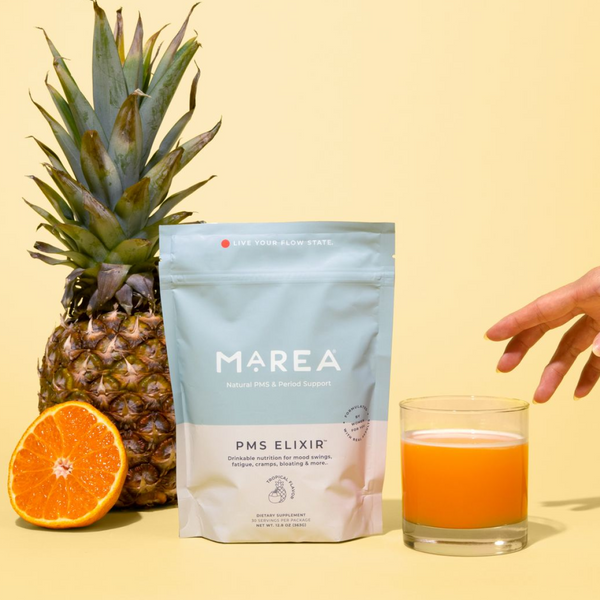
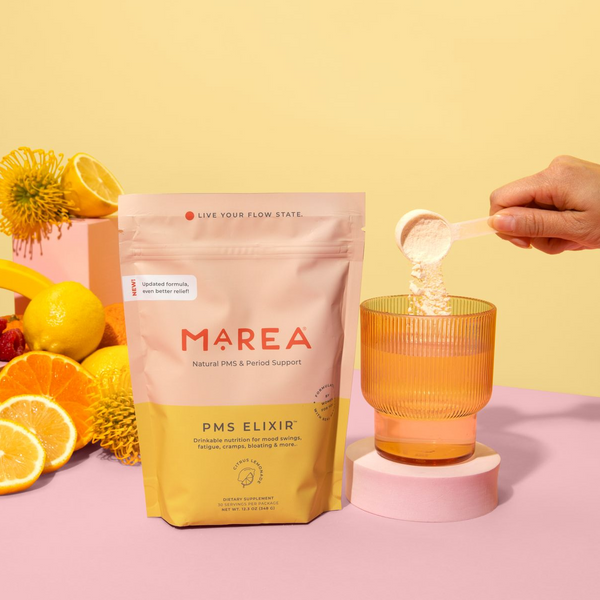
That's a lot of bottles to keep track of. The PMS Elixir combines 15 essential vitamins and minerals for period support into one drink a day, so consistency is the easy part.
[PMS Elixir banner image with alt text: "Marea PMS Elixir drinkable multivitamin"]
Track it. Log your symptoms for a few cycles with our free period symptom tracker. You'll see exactly when period flu hits, and whether what you're trying is working.
When to see a doctor
Talk to your doctor if:
-
Your symptoms are severe enough to disrupt your work, relationships or mental health. That can be a sign of PMDD, a more severe form of PMS that affects fewer than 5% of women (Office on Women's Health)
-
You have a higher fever, or a fever with chills, a cough or a sore throat
-
Your symptoms don't line up with your cycle
-
Over-the-counter pain relief isn't touching your pain
FAQ
Is period flu real? Yes, but it's not the flu. It's a set of flu-like PMS symptoms caused by hormone shifts and prostaglandins, not a virus.
Can PMS cause a fever? It can cause a low-grade fever before your period. A higher fever, or a fever with respiratory symptoms, is more likely an infection.
How long does period flu last? PMS symptoms usually start in the five days before your period and end within four days after it starts.
Can you get period flu after your period? Period flu usually fades within the first few days of your period. If you feel sick after it ends, something else is more likely the cause.
Is period flu contagious? No. It's hormonal, so you can't pass it on (though you're still allowed to cancel plans).
The bottom line
Period flu is your hormones and prostaglandins making themselves known, not a virus. You don't have to just white-knuckle through it every month: a few consistent habits, the right nutrients and a little tracking can take the edge off.
Sources
-
Cleveland Clinic. How your period can cause flu-like symptoms.
-
Office on Women's Health. Premenstrual syndrome (PMS).
-
Armour M, et al. (2019). Exercise for dysmenorrhoea. Cochrane Database of Systematic Reviews.
-
Fernández MM, et al. (2018). Premenstrual syndrome and alcohol consumption. BMJ Open. Summary via ScienceDaily.
-
Thys-Jacobs S, et al. (1998). Calcium carbonate and the premenstrual syndrome. American Journal of Obstetrics & Gynecology.